[ad_1]
 Crash games exploded worldwide around 2019, when SPRIBE’s Aviator launched at crypto casinos and spread like wildfire. By 2022, it had its own tab at most offshore sites. TikTok videos, Telegram groups, YouTube reaction channels. The format found an audience and the rest of the iGaming world scrambled to catch up. Pragmatic Play released Spaceman, eventually followed by High Flyer Crash in 2024. BGaming eventually put out Aviamasters. SmartSoft had JetX. The selection got deep quick. When it comes to what’s next, this is a timeless article; we go deep into what crash games are and what they aren’t. In all online markets, we find over 300 games in early 2026.
US players get a different number.
The big names, SPRIBE, Pragmatic, BGaming, SmartSoft, don’t power the casinos most American players can use. The US-facing offshore market runs mostly on RTG, Rival, Dragon Gaming, Betsoft, and a handful of smaller providers, and most of those weren’t rushing to build crash games. For a long time, if you were playing at an RTG or Rival casino and wanted a crash game, there wasn’t one if you weren’t comfortable playing with a VPN at an unlicensed cryptocurrency casino accepting American players.
That’s changed. Not completely, but enough to write about.
RTG’s SpinLogic built a crash engine and skinned it three different ways – sometimes the splash screen says RTG, it’s the same animal, either way. Rival shipped Astrochimp for US players. Dragon Gaming put out Chick vs. Croc, which isn’t quite crash but sits in the same neighborhood. Betsoft released Triple Cash or Crash with its three-astronaut setup. TaDa Gaming, a newer provider that does show up at US-friendly properties like WinADay, has Crash Touchdown along with a handful of other crash-like titles.
What follows is a look at what’s actually available, what’s worth playing, where the games come up short compared to the global market, and the honest math behind the 97% RTP number almost every single one of them advertises.
For context, the global crash market is stacked deep. What’s available outside the US includes:
- Aviator (SPRIBE): multiplayer social layer, provably fair RNG, no per-round win cap at most operators
- Aviamasters (BGaming): physics simulation model where you collect multipliers during a landing sequence, not a rising curve; half a million TikTok views at its peak
- JetX (SmartSoft): around 98.9% RTP, one of the highest in the format
- Spaceman (Pragmatic Play): partial cash-out lets you secure half your bet mid-round
- Hundreds more
These are mature games, some of them from providers who built crash as a primary format, not a side project. The US-facing games are catching up, not caught up. Knowing that going in makes it easier to appreciate what’s actually here.
The RTG Triple: Galaxy Blast, Ripcord Rush, and Under Pressure
 Spend five minutes with all three of these and you’ll realize RTG built one game. The UI is identical: leaderboard in the top left showing anonymized player bets, auto cash-out toggled to 1.50x by default, quick-bet buttons at $1/$5/$10/$25, a scrolling ticker of recent win multipliers across the bottom. The 22-25 player count visible in screenshots of all three suggests they may even share server pools.
Galaxy Blast has a rocket launching off an alien planet against a purple sky. Ripcord Rush has a skydiver in a propeller plane about to jump. Under Pressure has a pixel-art submarine descending through an ocean canyon. Different skins. Same engine. Same 97% RTP. Same $10,000 maximum win per round. Same 5,000x multiplier cap.
The $10,000 cap: At a $5 bet hitting 500x you’d expect $2,500. Fine. At $25 hitting 500x you’d expect $12,500. RTG pays you $10,000 according to the rules. The gap gets real once your bets get very big. Remember the 50,000x line bet max payout on their slots? This is a bit like that, except you can’t game the system by betting $1 a line on five lines instead of $0.25 on all twenty – the cap is the cap. RTG simply decided operator exposure stops at $10k. So the 5,000x ceiling is basically theoretical for anyone betting more than $2 a round.
The RTG gameplay is clean. Auto cash-out works if you go with that, the leaderboard gives you some sense of where other players are getting out without being distracting, the pace feels right, not so fast you can’t think, not slow enough to get boring.
What’s missing is anything that makes one of these three different from the other two. No analytics panel showing your personal cash-out history. No dual-bet positions. No provably fair seed verification. These are usable crash games on a straightforward engine, but they feel like a provider checking a box rather than doing much of anything interesting with the format.
The multiplier ticker showing recent round results works, and it’s something even some bigger-name crash games skip. Seeing that the last ten rounds crashed at 1.2x, 1.4x, 1.1x, 8.6x, 1.5x doesn’t tell you anything statistically. Each round is independent; past results don’t predict future ones. But it gives your brain something to anchor on. Whether that does you any good is debatable.
If you’re at an RTG casino and want crash, play whichever one is in the lobby. The game is the same. If you can’t find one in the lobby menu, you can use the magnifying glass and search by game title.
Astrochimp (Rival Gaming)
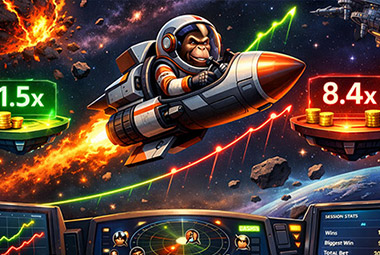 Rival built something a it more advanced here. Astrochimp does dual-bet positions: two bets at the same time in the same round, which is the thing that makes Crash interesting once you get past the basics. One at 1.5x auto cash-out, one on manual at whatever you’re chasing. The safe bet can keep your bankroll alive longer. The risky one is where the money is, or at least where the shot at the money is.
Rounds run fast. Somewhere around 7-8 seconds on average, quick even by crash standards. Fifty rounds at that pace is under ten minutes. A session can disappear before you notice it. A good run can pile up just as fast, which works both ways.
At ~8 seconds a round, $5 flat bets across an hour of play is around $2,250 in total wagering. Factor that against your bonus requirements if crash games are allowed before you start. Also, check whether Astrochimp counts at full contribution or at a reduced rate at your casino.
The analytics panel is a real addition. Historical data on your sessions, other players’ cash-out points displayed, stats on round outcomes. Not every player cares about this, but the ones who do are exactly the kind of player who thinks about variance. Rival clearly built Astrochimp for that player rather than the casual slot spinner who stumbled onto the crash tab.
RTP confirmed at 97%. Provably fair hash.
The chimp-in-space theme might seem silly, but the underlying game has more going on than Galaxy Blast does. If you’re at a Rival casino and want to actually learn how crash works, start here.
Chick vs. Croc (Dragon Gaming)
Worth explaining before you play it, because it doesn’t behave like standard crash.
Instead of a multiplier climbing a curve until it crashes, Chick vs. Croc sends a pixel-art chick hopping across crocodile backs floating in a swamp. Each croc is a cash-out point. The chick lands, you can cash out, and then it either hops to the next one or gets eaten. The multipliers on the visible crocs (100, 104, 109, 114 on the screen) are your payout if you get out at that point. As you progress, more become visible.
The volatility selector at the bottom is what makes this different from anything else in this list:
- Low: more frequent small wins, the chick hops further on average
- Med: balanced, reasonable middle ground
- High: rounds end faster, but surviving longer pays more
- Xtreme: most rounds end early; the ones that don’t can run a long way
Before the round starts, you’re choosing how the risk curve is shaped. Manual and Auto modes are both available.
This is a pre-round volatility choice, not a cash-out timing game. If you normally play high-volatility slots and like the feeling of swinging big, Xtreme mode is the closest thing to that experience in this list.
This sits closer to a mines game than to Aviator-style crash. Each hop is a binary decision. Cash out now or risk the next croc, rather than the continuous tension of watching a multiplier curve. Different psychology entirely. Some players will prefer the discrete steps. Others will find it slow.
Dragon Gaming doesn’t publish RTPs as openly as some providers, so hedge the implied 97% a little. The game is genuinely different enough from the rest of this list to be worth a look if you’re at a Dragon Gaming casino.
Triple Cash or Crash (Betsoft)
Betsoft went the opposite direction from simple. Three rockets, three astronauts, three independent bet positions all running in the same round. Each astronaut gets its own bet amount and its own auto cash-out target, and all three track the same multiplier curve at the same time.
In practice, this builds in the variance-mixing that single-bet games make you manage manually. With three positions already decided before the round starts, one conservative, one medium, and one high, the work happens in the background. Every round, you’re covering multiple risk levels against the same curve without having to think about it mid-round. A round that crashes at 2x is a small win on position one, a loss on position two, a loss on position three. A round that hits 8x is a win everywhere. The shape of your session gets more interesting than flat-betting one target ever manages to be.
Simple setup that works: Position 1 auto cash-out at 1.5x. Position 2 auto cash-out at 5x. Position 3 manual, chasing whatever you feel like. You’ve got survival, a medium target, and a moonshot running every single round without adjusting anything. Compare it to three bets on a roulette table – Odd/Even (Black or Red), second column or section, and a straight number bet to get a better feel for the variance spread and an idea about the game results you might expect.
The published max multiplier is 100,000x. The real ceiling is a max player profit of €200,000 across all three positions in a round if enforced by the casino. Check the terms. Much higher than the RTG $10,000 per-round limit. In practice, that multiplier almost never shows up, but for high-bet players the ceiling is quite a bit better here.
RTP is 96%, a point lower than the competition. That compounds over long play and is worth knowing.
One thing the rules call out specifically: if a manual cash-out and the rocket explosion happen at the same moment, you lose. The game flashes red warnings when latency is a problem. If your connection is anything less than solid, use auto cash-out on all three positions.
TaDa Gaming: Crash Touchdown and the Rest
We were able to access TaDa Gaming titles at WinADay in real-money mode without a VPN from a US state. That’s the verification that matters for a US-focused piece. Most US players haven’t heard of TaDa, but the crash catalog is bigger than you’d expect:
- Crash Touchdown: football theme, special card fragment bonus system
- Crash Goal: soccer theme
- Crash Puck: hockey theme
- Crash Fruit: fruit theme
- Crash Bonus: standard crash with bonus layer
- Go Rush: limbo variant
- Mines Gold: crash-adjacent mines format
That’s a real library sitting at reputable US-facing properties, not theoretical availability somewhere.
Crash Touchdown is the flagship. Standard crash mechanics with one wrinkle: each round gives you a chance to collect card fragments, and completing a full set gets you bonus rewards from a prize pool ranging from 1x your bet up to 100x. Look at it like a secondary reward layer running parallel to normal play, which is more than most of these games give you on top of the basic mechanic.
The minimum cash-out is 1.01x, which means the game can’t crash before you have any chance to act. The RTG games don’t guarantee this in the rules, at least nothing we found tells you. A crash at or below 1.00x is possible there, and you lose your bet with no opportunity to cash out. Small design detail, real practical difference.
Max multiplier is 500x, max bet is $100, which puts a ceiling on winnings at $50,000 per round. Lower than Betsoft but higher than the RTG caps. The rules also include provably fair seed verification, a transparency feature few of the other games mention.
The 97% RTP Problem
 Every game in this article advertises somewhere around 97% RTP. Some are 96%, most are 97%. They all mention this number as if it means something useful for your session tonight.
RTP is calculated from the probability of every possible outcome at every possible multiplier point. That’s what the math pays back across the full distribution of results if the game runs forever. It’s not based on player behavior or strategy. A round that crashes at 1.00x before anyone can cash out is baked into that number just like a round that hits 500x. The house edge is chiseled in stone. No matter what you or any other player decides to do at any microsecond, it doesn’t move.
What that number doesn’t tell you is what happens in your actual session. What drives that is variance, specifically the variance you create through your own cash-out decisions. Target 1.5x every round and you’ve built low volatility yourself. You’ll hit maybe 65-70% of rounds, collect small wins, and slowly grind down through the house edge. Chase 50x every round and you’ve built high volatility. Most rounds you lose everything; occasionally you win big. The 97% RTP describes neither experience. It describes what happens to the full distribution of all possible outcomes across millions of rounds.
Slots work differently. The volatility is baked into the paytable by the designer. You pick a game and accept whatever variance profile the math models built in. A high-volatility slot like Dead or Alive II has long losing streaks and rare massive wins because the designer built it that way. A low-volatility slot pays small wins often because that’s what the symbol frequency and paytable produce. You don’t get to choose. In crash games, you set it yourself, which is either the feature or the trap depending on how disciplined you are. Most players aren’t. Casinos probably love that about the format.
Games with more than one bet position do some of that work in the background, since you’ve already decided before the round starts how to spread across high, low, and medium volatility. One auto cash-out at 1.5x, one manual position at 20x, every round, automatically. Single-bet games put that completely on you, and most players probably don’t manage it well. Either too conservative and grinding down slowly, or too aggressive and busting out fast – or all over the place trying to chase a lucky hit – which can go the other way several times a minute.
The RTP difference between 96% and 97% sounds small. On $10,000 in total wagering it’s $100. On $100,000 in wagering, which a regular player hits in a few months at these round speeds, it’s $1,000. Choose the higher RTP game when everything else is equal – you are already choosing the volatility.
None of it changes the house edge. The casino keeps its 3% over the course of time regardless. What changes is the path through that 3%. Slow over two hours or fast in twenty minutes in most cases, or somewhere in between.
One more thing the 97% doesn’t tell you: whether the game counts toward bonus wagering at your casino. Crash games are new enough at US-facing properties that the rules can vary. Some operators exclude them completely the way they exclude progressive jackpot slots. Others might let them contribute at a reduced rate, 10 or 20 cents on the dollar instead of full credit.
Check the bonus terms before you play. Clearing $5,000 in wagering requirements at 20% contribution means $25,000 in actual play through the games. At 8-second rounds that’s hours of real session time you may not have budgeted for. Another thing to check is if there is a max cash-out term attached to your coupon – it doesn’t make much sense to shoot for the moon, then leave most of “your” money on the table.
There’s also a latency problem that RTP doesn’t seem to account for. Manual cash-outs depend on your connection being fast enough that your click registers before the crash. Betsoft explicitly warns about this. RTG’s rules mention connectivity issues too. On a spotty connection playing manual, you will miss cash-outs you meant to hit. Auto cash-out eliminates that: set your target and let the game execute it. Playing manually because it feels more in control is just adding human error on top of a 3% house edge that’s already working against you.
FAQ
- Are crash games available at most US-facing casinos?
No. The selection is still thin compared to European and crypto casino markets. RTG casinos usually have at least one SpinLogic crash game in the lobby. Rival casinos have Astrochimp. Betsoft properties carry Triple Cash or Crash. Casinos running only one or two software providers might not have a crash tab at all.
- Do crash games count toward bonus wagering?
Depends on the casino and the specific bonus terms. Some operators exclude crash games from bonus play, they same way they handle network progressive jackpot slots. Others let them contribute at a reduced rate. Read the terms before playing crash on a bonus. Assuming full contribution or full cashout and being wrong could be an expensive mistake.
- Is the 97% RTP real or marketing?
It’s a real calculated number, and it’s basically meaningless for any individual session. RTP describes theoretical return across millions of rounds covering every possible outcome. Your session is dominated by variance regardless of whether the number is 95% or 98%. The difference mostly matters over a lifetime of play: choose higher RTP when everything else is equal, but it won’t predict or protect your results in a single session. Better chances? Of course, but it’s still random if they happen to turn into a payout in any given session.
- Which game has the best setup for managing variance?
Triple Cash or Crash for the three-position structure if you’re at a Betsoft casino, 96% RTP notwithstanding. Astrochimp’s dual-bet positions at Rival casinos. The RTG SpinLogic games are single-bet, which means managing variance is completely on you, every single turn.
- What’s the biggest practical difference between these games and Aviator?
Mostly, the per-round win caps and the single-bet limitation on most of them. Aviator runs at crypto casinos with high max bets, higher per cashout thresholds, and no hard per-round win cap in most cases. The US-facing games have lower caps across the board, but you need to check the terms where you play. Betsoft and Rival have built-in multi-position structures. The underlying math is similar. The ceiling on what a good round pays can be lower.
[ad_2]
Best Crash Games at USA Casinos 2026
Related Posts

Perlombaan Yunani, Spanyol dan Portugal untuk mengandung kebakaran hutan saat UE meningkatkan bantuan lintas batas
[ad_1] ATHENS, Yunani (AP) - Awak api di Yunani, Spanyol…

Pemimpin Eropa dari “Koalisi Bersedia” untuk mengadakan panggilan konferensi atas pertemuan Trump-Putin “Langsung | Ukraina
[ad_1] Para pemimpin Eropa dari 'Koalisi The Willing' mengadakan panggilan…

Berita Kasino Terkini Dari tim LCB »Kasino Online & Berbasis Darat
[ad_1] Kunjungi ruang redaksi LCB untuk berita kasino terkini dan…