[ad_1]
Slots started out pretty simple. Three reels, a handful of symbols, a lever. You knew exactly what you were looking at. That world is long gone.
Modern slot games come loaded with proprietary engines, branded reel systems, layered bonus structures and mechanics that have their own names, logos and sometimes their own licensing agreements. If you’ve ever opened a game, seen what might look like a little badge in the corner that says “Megaways” with a random number in it, and had zero idea what it meant for how the game actually plays, this is the explainer you needed before you deposited. (Hint – it’s the number of virtual paylines for that round, and it changes with every spin).
What “Mechanics” Actually Means Here
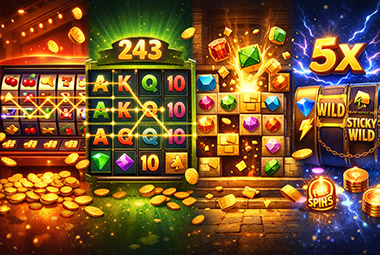 A mechanic, in slot terms, is just the system that decides how you win.
The oldest version of this is paylines, fixed paths across the reels where matching symbols have to land. Five reels, 25 paylines, three matching symbols on one of those paths from leftmost to right, and you win. Simple enough that you can explain it to someone who’s never touched a slot in their life.
Ways are the next step up. Instead of fixed paths, ways count every possible left-to-right combination of matching symbols landing anywhere on adjacent reels, still starting from the left-most position. A 243-ways game pays you any time a matching symbol lands in adjacent columns, regardless of row. More ways means more chances to hit something on any given spin. It doesn’t mean you win more money overall, just that wins show up differently.
Cascades, also called avalanches or tumbles depending on who made the game, take it further. When you win, the symbols that paid disappear and new ones fall in to replace them. One paid spin can produce four or five wins in a row before anything stops moving. The catch is that games built around cascades usually run at lower volatility on any single cascade. They’re designed to chain, not to pay big on the first screen with a winning combination.
Multipliers are exactly what they sound like. A 5x multiplier on a win turns a $2 win into $10. Where it gets interesting is when multipliers stack, grow with each cascade, or carry over into a bonus round. That’s when the numbers can get very interesting.
Wilds substitute for other symbols to complete wins, same as they always have. Expanding wilds stretch to cover a full reel. Sticky wilds stay locked in place for a set number of spins. Walking or rushing wilds move one position per spin. The variations are endless, and the names change by studio. Wilds can also be multipliers.
Scatter symbols usually don’t need to land on a payline; three or more anywhere on the reels trigger something, usually it’s free spins.
That’s the vocabulary. Everything below will fit into that.
Megaways: The Engine That Changed Everything
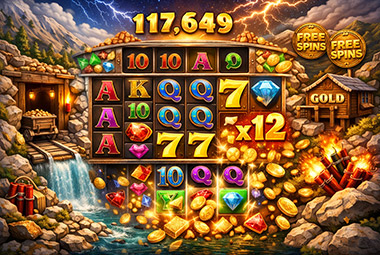 Big Time Gaming built Megaways around 2016 and it rewired how the whole industry thinks about reel design.
The idea is that each reel can show a different number of symbols on every spin, anywhere from two to seven, usually. The number of ways to win changes with every spin as a result. On most Megaways games, you’re looking at a maximum of somewhere around 117,649 ways, but it varies. On some spins, you might have 324 ways. On others, the full amount. You never know until the reels land.
BTG paired that variable grid with cascades and scatter-triggered free spins as a starting point. The combination turned the second and most recognizable title, Bonanza, into one of the most talked-about slots of an era. The free spins in Bonanza have an unlimited multiplier that goes up with every cascade. That’s where the big numbers live, and it’s also why most players will never see them.
Because Megaways is a licensed engine, other studios can build their own games on top of it. Blueprint, Pragmatic Play, NetEnt and Red Tiger all have Megaways titles. Some are originals. Some are conversions. Gonzo’s Quest Megaways takes an older NetEnt game and Red Tiger rebuilds it on the BTG reel system. The Megaways counter on the game screen tells you it’s the real thing, licensed from BTG, not a lookalike. The word is the brand, is the engine, is the real deal.
BTG also built Megapays – a progressive jackpot layer that can sit on top of Megaways math, and Megaquads, which runs four reel sets at once and pushes ways counts past what the original engine could do.
Yggdrasil GEMs: A Whole Menu of Branded Engines
 Yggdrasil went a different direction. Instead of one marquee engine, they built a library of 13 branded mechanics they call GEMs (Game Engagement Mechanics). The GEMS are licensed to partner studios that make games inside the Yggdrasil network.
The result is that you can play a game made by a smaller studio you’ve never heard of and still be using a Yggdrasil mechanic, because that studio is using Yggdrasil’s system.
A few of the more common ones:
Splitz shows up as mystery tiles that can split into multiple copies of the same symbol. Land one on the reels during free spins and what looked like a single position suddenly counts as two, three, or more matching symbols. It’s a ways-booster more than anything else.
GigaBlox introduces oversized symbols like blocks that span two, three, or four reel positions at once. When a giant symbol lands, every cell it covers counts. Paired with ways, a 3×3 giant symbol covering part of three reels is doing a lot of heavy lifting.
DoubleMax runs a global multiplier that doubles with every cascade. One cascade is 2x. Two cascades is 4x. Three is 8x. You can see how that compounds fast during a hot free spins round, and you can also see why most free spins rounds end at 2x.
OnlyWins is interesting from a design standpoint. It’s basically a filter that removes non-winning spins in certain modes, so every result during a feature pays something. Lower volatility by nature of its construction.
The other GEMs cover wilds with built-in ways to manifest, wilds that move and escalate multipliers, jackpot systems, and hit-rate boosters. Yggdrasil publishes the full list; the studio pages usually tell you which GEM a given game uses.
Nolimit City xMechanics: Built Around Extreme Volatility
Nolimit City is a studio that targets players who want the absolute ceiling to be as high as possible, and their xMechanics suite is built around that.
xWays works similarly to Splitz. Mystery symbols that expand to reveal two to four copies of the same symbol in a single position, increasing both symbol height and the ways count. It shows up in San Quentin, Punk Rocker, and East Coast vs West Coast, among others.
xNudge is the one that built Nolimit’s reputation. Wilds that nudge onto the reels bring a multiplier with them; each nudge step adds to it. In Tombstone and Deadwood, landing a full reel of nudging wilds during free spins with a stacked multiplier is how the slot achieves its max win potential. It’s rare. That’s the point.
They’ve built about 20 registered xMechanics, all told: xSplit (symbol splitters), xBomb (removes symbols and bumps multipliers), xLock, xBet, and more. Most Nolimit games combine two or three of these. The studio has also started licensing xMechanics to outside developers, or at least sharing them among sibling studios in the Evlution family, so you should start seeing them in games that aren’t Nolimit originals.
One thing to know going in: Nolimit games are absolutely high volatility. The math is built for players who are comfortable with long, cold stretches in exchange for a real shot at something big. If that’s not your thing, the games will feel brutal.
ELK Studios X-iter: Buying Your Way In
 ELK Studios took a different problem as their starting point. Some players want features and don’t want to grind through the base game to get there. X-iter is their answer to that.
It’s a menu of up to five modes per game, ranging from enhanced base-game play (higher feature frequency, not buying into the bonus outright) to direct entry into the regular bonus to direct entry into a super bonus. The costs range from around 25x stake to 300x stake, depending on the mode and the game.
Most casinos in markets where bonus buys are legal show the X-iter menu as its own button. In markets where direct bonus buys aren’t allowed, ELK often still makes the lower-tier enhancement modes available . They’re structured as ante bets rather than purchases, which is a meaningful legal difference.
X-iter debuted in a game called Bompers and has since shown up in Nitropolis 3 and 4, Pirots 3, Cygnus 4, and others. ELK also has what they call Betting Strategies built into their games — preset stake management patterns (Booster, Optimizer, and a few others) that automatically vary your bet size according to a pattern. These don’t change the RTP, just the bet size on any given spin.
Push Gaming: Collectors, Persistent Symbols, Push Bet
Push Gaming’s slot identity revolves around collector mechanics when you look closely. They make games where a specific symbol type spends the feature gathering things. In Big Bite Push Ways, orca symbols swim the grid collecting fish and jackpot tokens. In Jammin’ Jars, fruit jars expand and collect matching symbols. The collection itself is the feature, not just a trigger for something else.
Push Ways, their newest reel system, uses nudging Hot Zones that split any symbol they pass over into two, pushing ways up as high as 262,144. It’s a ways engine, but the growth mechanic is different enough from Megaways that it gives gameplay a very different feeling.
Push Bet is their ante-bet system. Pay a 50% stake increase to boost your chances of triggering the bonus on any given spin. Push says in their materials that your chance is around 148% higher with the 50% increase in stake. It’s not a bonus buy, it’s more like tipping the scales toward getting there faster while still playing the base game. Maybe a “best of both worlds” solution.
Games Global / Microgaming Stack: The Invisible Platform
This one doesn’t have a logo you’d recognize on the game screen, but it’s worth knowing about because it shows up in so many games from so many studios.
Games Global runs what’s essentially a shared platform that a handful of internal labels, Gameburger, All41 Studios, and 38 others, all build on. Some of the reusable mechanics in that stack include Link&Win (their branded hold-and-win system, with sticky coin symbols and fixed jackpots. We first saw it in Hyper Gold, butit could have come sooner or from a studio other than Gameburger in backrooms), Hyperspins (a respin system that lets you pay to respin individual reels after a spin, usually to chase a scatter or complete a feature), and Jumbo Blocks (oversized symbols that work similarly to GigaBlox but live in this ecosystem) and a few others. These feature mechanics tend to bubble up out of individual in-house or partner studios, but they could be invented in the Portfolio Studio or virtual “Center of Excellence,” where the maths and other elements get adjusted for game variants – they’ve never been too transparent about what goes on inside the network.
None of these are as loud about their branding as Megaways or xMechanics. They tend to just be part of how the game works, which is why you might have played quite a few Games Global titles without realizing it.
The Generic Ones: No Badge, No License, Everywhere
Hold and win, also called hold and respin, sticky respin, coin collect, and about a hundred other names, is the most copied mechanic in modern slots. A set of reels triggers when you land enough special symbols (usually coins). Those symbols stay locked. You get a fixed number of respins, which reset any time a new coin lands. Fill the grid or hit jackpot positions for the big pay. It’s everywhere, it’s not licensed as far as we can determine, and nearly every studio has their own version of it.
Tiered free games – where landing additional scatters during a free spins round upgrades you to a better version with higher multipliers or more spins, seem to be generic too. The names change. The structure? Not so much.
Multi-stage scatter triggers, expanding symbol mechanics, level-up bonuses where hits during a feature fill a meter; all of those spread across the industry without IP barriers. The studios that do it best just execute the math and presentations better.
FAQ
- What’s the difference between ways and paylines?
Paylines are fixed paths where symbols have to land in a specific pattern. Ways count every left-to-right combination across adjacent reels. A 243-ways game pays any time three matching symbols land in columns one, two, and three, regardless of which row they’re in. More ways means more winning combinations are possible on each spin, so it just stands to reason that most of those combinations would pay less as well. That’s not necessarily low volatility, but it can be.
- Does buying a bonus with X-iter or Push Bet change the RTP?
Usually not, or barely. Some studios build the bonus buy at a marginally different RTP than the base game, but it’s usually within a fraction of a percent, just trying to get the maths to match up perfectly. What changes in a way that matters is how you get there. You’re paying to skip the base game, not to change the odds once you’re in the feature.
- Are Megaways games more volatile than regular slots?
Most are, yes. The combination of variable ways and cascading multipliers during free spins can push both the ceiling and the variance up. That said, volatility is a math setting, not a Megaways property. A low-volatility Megaways game is absolutely possible in theory, but it’s just not common in practice.
- What does “licensed mechanic” mean for a player?
Not much, really. It means the studio paid to use someone else’s engine, so there’s consistency in how that mechanic behaves across games. Megaways plays about the same whether you’re in a Blueprint game or a Pragmatic Play game because it’s the same underlying system. The theme, math model, and bonus structure around it can still vary a lot.
- Are xMechanics games really as volatile as some people say?
Yes. Nolimit builds for the player who wants max win potential and accepts that most sessions will end without a big hit. If you go into a Nolimit game expecting it to feel like Starburst, you’re probably not going to have a good time.
[ad_2]
Bonus Buys, Hold & Win, xWays in 2026
Related Posts

Tiga tewas, delapan terluka dalam penembakan di klub New York yang ramai di tengah rekor tahun kekerasan senjata rendah
[ad_1] NEW YORK (AP) - Tiga orang tewas dan delapan…

Perang mengamuk di Ukraina sebagai Trump dan Putin bertemu tetapi jangan mengumumkan kesepakatan
[ad_1] Yaitu 11 tidak didukung. Untuk pengalaman yang optimal, kunjungi…

Rekam jumlah orang Amerika melihat minum sedang berbahaya: jajak pendapat
[ad_1] WASHINGTON (AP) - Lebih sedikit orang Amerika melaporkan bahwa…